Project Title: Strengthening Capacity for Sustainable Disaster Management Network by involving multi-sectoral platform Project Period: 17 January, 2024– 16 January, 2025 (12 month)
- Project Activities and Accomplishments
Bangladesh’s historical narrative, both before and after its independence, is heavily influenced by a range of disasters, largely driven by natural hazards. Situated near the Bay of Bengal, the nation faces the frequent threat of tropical cyclones that originate in the Indian Ocean. These powerful storms intensify as they approach the Southeast Asian region, with Bangladesh being one of the most affected countries. Storms are the most common disaster type encountered by the nation and have historically caused widespread devastation. The geographical makeup of Bangladesh, characterized by its extensive river delta systems and a monsoon climate, significantly heightens the risk of flooding. These floods rank as the second most common disaster affecting the country, often exacerbated by storm surges associated with cyclones. In addition to these challenges, Bangladesh is also vulnerable to landslides that typically occur in the wake of storms and heavy rainfall, alongside other hazards like earthquakes, extreme temperatures, and widespread epidemics that can arise in the aftermath of such disasters. The impacts of climate change are becoming increasingly apparent, further exacerbating Bangladesh’s susceptibility to these hazards.
A-PAD Bangladesh initiated its project in January 2023, with ongoing efforts continuing from January 17, 2025, aimed at enhancing capacity in disaster management. The organization engages with various sectors, including local communities, community leaders, stakeholders, and government officials, through continuous training sessions focused on disaster management. To facilitate these training programs, A-PAD Bangladesh staff organized small community meetings to share insights on disaster preparedness and to introduce participants to the activities of A-PAD Bangladesh. The organization operates across eight divisional areas.
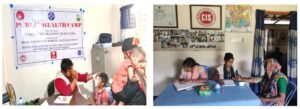
In each division, there is one health worker responsible for conducting home visits to raise awareness within the local community regarding fundamental disaster management issues. These health workers also disseminate crucial information concerning government directives or any disaster-related announcements to the community. As of September 2025, A-PAD Bangladesh has successfully benefited a total of 3,099 individuals.
A-PAD Bangladesh also participated in coordination meetings held in the eight divisions at the Office of the Deputy Commissioner. These meetings included various NGOs that presented their activities and discussed future initiatives in collaboration with government bodies and NGO partners.
1. Strengthening of disaster risk reduction and disaster response system functions through the Emergency Disaster Management Coordination Center | ||
Activities | ( Outcome 1 ) The Emergency Disaster Management Coordination Center operated under this project will function as a disaster response base in each region, leading to the disaster risk reduction in the community and the strengthening of its disaster response system.: | Project Status: Achievements vs Outcome: If the activity is behind the schedule, please write the reason. |
1-1 Operation of Emergency Disaster Management Coordination Centers Target:Local communities 10 people×25 days×8 divisions×12 months =24,000 people | 【Indicators of Outcome】 1-1 The Emergency Disaster Management Coordination Center will be used for coordination meetings among partner organizations and relevant stakeholders during normal times, and will also serve as a center for health and public health guidance for the local residents. In the time of emergency, health services will be provided by emergency health workers. The Emergency Disaster Management Coordination Center will be used by 24,000 local residents (annual average) in the target area. (Indicator:number or visitors, record of services provided)
1-2 Through the Disaster Management Awareness Program, community residents will receive the latest disaster information and knowledge on how to respond to disasters, and people’s awareness of disaster prevention and response will be increased. (Indicator:Community disaster preparedness report) | Total 2,342 people visited to the Disaster Management Coordination Center to discuss about disaster preparedness and health related issues. Dhaka: 260 Persons Cox’s Bazar: 290 Persons Pabna: 330 Persons Bagerhat: 305 Persons Patuakhali: 310 Persons Habiganj: 298 Persons Rangpur: 275 Persons Netrokona: 274 Persons Total = 2,342 Persons |
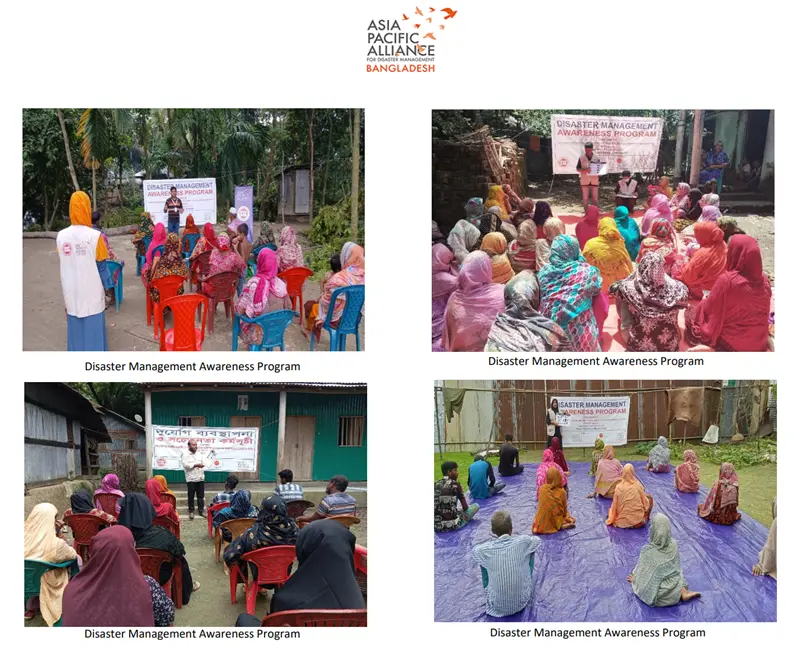
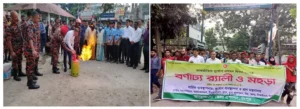
1-2 Disaster Management Awareness Program Target:Local communities, Community leaders, Local NGOs, Private company workers, government officials 15 people × 8 divisions × 4 times ×12 months =5,760 | A-PAD Bangladesh conducted Disaster Management Awareness programs at the 8 divisional areas where 496 persons have participated. Total 4 times training organized at each divisional areas. Dhaka:15 Participantsx 4 Sessons= 60+3=63 Participants Cox’s Bazar: 15 Participantsx 4 Sessons= 60+1=61 Participants Pabna: 15 Participantsx 4 Sessons= 60 Participants Bagerhat: 15 Participantsx 4 Sessons= 60+2=62 Participants Patuakhali: 15 Participantsx 4 Sessons= 60 Participants | |
people |
| Habiganj: 15 Participantsx 4 Sessons= 60+5=65 Participants Rangpur: 15 Participantsx 4 Sessons= 60+2=62 Participants Netrokona: 15 Participants x 4 Sessons= 60+3=63 Participants |
2. Expansion of disaster management network to improve community vulnerability | ||
| (Outcome 2)The network of NPF will be expanded and the capacity of each region for disaster prevention and response will be strengthened. |
|
2-1 Network Partner Meeting Target : Local communities, Community leaders, Local NGO, Private Company Workers, Government officials 50 people × 5 villages × 8 divisions = 2,000 people | 【Indicator of Outcome】 2-1 Strategies, mechanisms, and action plans for disaster reduction cooperation are developed in each region through discussions at network partner meetings, and a framework for disaster reduction cooperation is established. (Indicator:Strategic Plan) 2-2 MOUs signed with at least 5 new organizations, including private companies, in A-PAD Bangladesh NPF to expand the network (Indicator:number of new MOUs signed) 2-4 Resources possessed by A-PAD BGD partner organizations are provided in emergency disaster response, and play the role of that organization in times of emergency. (Indicator:List of resources such as supplies, human resources and donations provided by partner organizations for emergency disaster response) |
|
2-2 Disaster Preparedness Campaigns Target:Partner organizations and local communities 50 people × 2 times × 8 divisions = 800 people |
| |
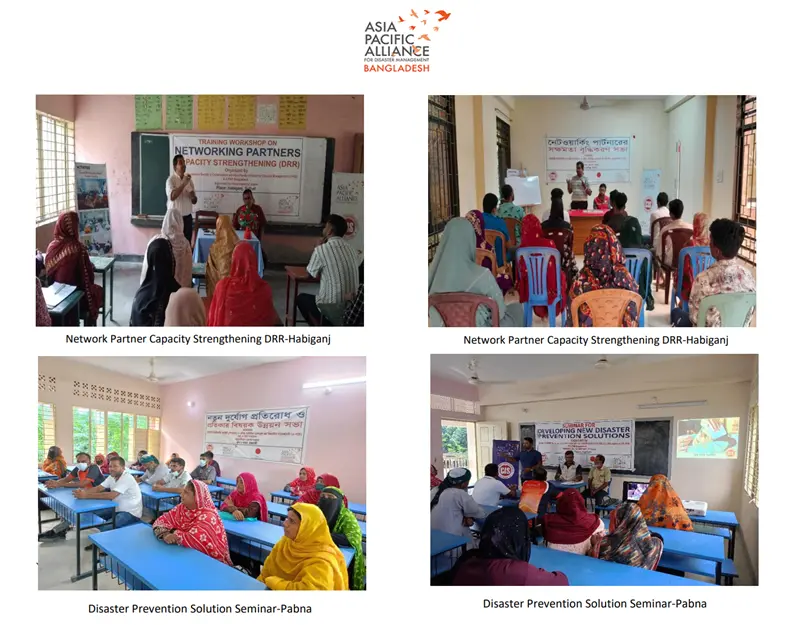
2-3 Network Partners Capacity Strengthening (DRR) Target : Partner organizations | A-PAD Bangladesh conducted Networking Partner Capacity Strengthening DRR at Habiganj where 45 persons have participated from 2 Organizations.
20-21 September 2025, Habiganj, Total 40+3=43 Participants | |
20 people × 2 organizations × 2 times × 8 divisions = 640 people |
|
CIS organized 2 days training programs in Habiganj. The primary objective of this training program is to enhance the capabilities of partner organizations within a network to effectively plan for, mitigate, respond to, and recover from disasters. This initiative transcends mere knowledge transfer by establishing sustainable institutional capacity that fortifies the entire humanitarian or development ecosystem. Participants will be introduced to essential concepts such as hazard, vulnerability, capacity, and risk, as well as the Disaster Risk Reduction (DRR) cycle, which encompasses Prevention, Mitigation, Preparedness, Response, and Recovery.
The training will also cover global frameworks, including the Sendai Framework, and will provide practical skills in conducting community-based risk assessments, hazard mapping, and vulnerability and capacity analysis. Additionally, guidance will be offered on the development of local DRR plans and the integration of DRR principles into ongoing development projects. Participants will receive training on crafting contingency plans, establishing emergency protocols, conducting simulation drills, and managing supplies effectively. |
2-4 Seminar for Developing New Disaster Prevention Solutions Target : NGO, Disaster | A-PAD Bangladesh conducted Seminar at Pabna and Netrokona where 33 persons have participated. 03-04 September 2025, Pabna, Total Participants 30+5= 35 Participants |
prevention related government organizations, Private sector personnels 30 people ( 2days ) × 8 divisions × 2 times = 480 people |
| 15-16 September 2025, Netrokona, Total Participants 30+4= 34 Participants
CIS organized seminar for forward-thinking, solutions-oriented event held in Pabna, bringing together local stakeholders, experts, and community representatives. The primary focus was to move beyond traditional disaster response and collaboratively brainstorm, develop, and initiate innovative, context-specific solutions for disaster prevention in the Pabna region.
· Flood Management: Innovating for the recurring flood risks from the River Ichamati and other water bodies. · Waterlogging & Drainage: Addressing post-flood and monsoon waterlogging that disrupts lives and agriculture. · Climate-Smart Agriculture: Developing solutions to protect livelihoods from erratic weather, river erosion, and seasonal droughts. · Early Warning Systems: Enhancing last-mile communication and community-led alert mechanisms.
This seminar was a dynamic, solutions-focused event convened specifically for Netrokona, bringing together local government officials, NGO partners, community leaders, technical experts, and representatives from the agricultural and fishing sectors. |
|
| The core mission was to pivot from traditional disaster response towards proactive, innovative, and context-specific prevention strategies tailored to the unique challenges of the Netrokona region, particularly its vulnerable haor (wetland) areas.
· Flash Flood Management in the Haor Basin: Innovating to protect lives, the critical Boro rice harvest, and fisheries from sudden inundation. · Climate-Resilient Livelihoods: Developing solutions for pre-monsoon droughts (Monga) and unpredictable rainfall that threaten agricultural and fishing cycles. · Advanced Early Warning Systems: Enhancing the accuracy, speed, and community reach of flash flood alerts. · Sustainable Water Management: Addressing post-flood waterlogging and promoting efficient water use for irrigation. |
2-5 International Symposium on DRR
Target : Government, Local government, private company, NOG, partner organization, representative of A-PAD member countries, etc. 200 people |
|
4. Practical training to improve resilience of local communities | ||
| ( Outcome 3 ) Contribute to improving the disaster resilience of local communities through practical training. |
|
3-1 Disaster response capacity building of local community level in Health and hygiene field | 【Indicator of Outcome】 3-1 a) Establish networks of community leaders who can lead disaster response and emergency health response in all districts of Bangladesh. (Indicator:Number and the List of community leaders for disaster response/emergency health in each 8 districts.) b) Networks of human resources with the skills and know-how to respond to health emergencies will be established in all districts of Bangladesh to provide health services to the local residents in times of emergency. (Indicator:Data of NGO health personals who can respond in emergency. Number of residents who received the services in the cases of activities during emergency disaster in each 8 districts.)
3-2 a) Disaster preparedness training and drills will be documented in a manual, and women, youth groups, and local stakeholders who |
|
3-1 a) Workshop on Disaster Management and Emergency Health Response
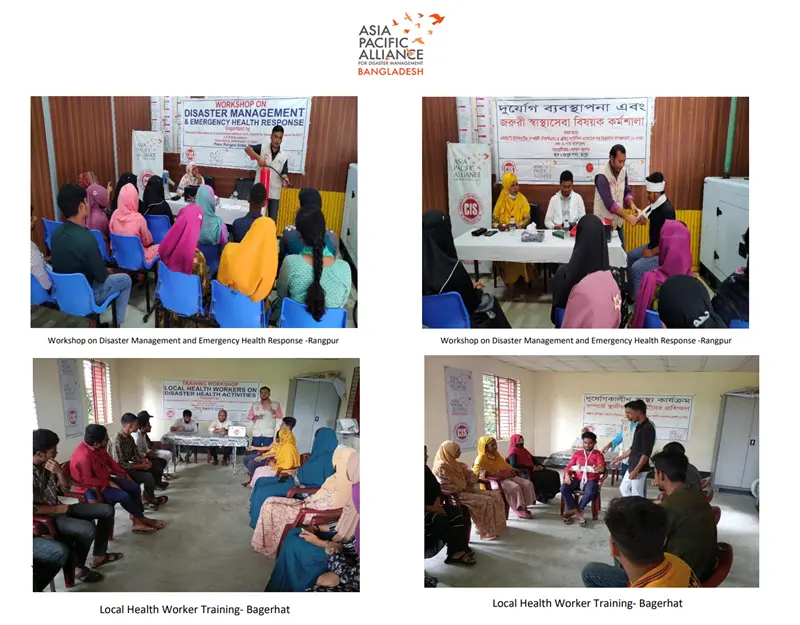
Target : Local residents, Community leaders, Local NGO workers 25 people ( 2 days ) × 8 divisions × 2 times = 400 people | A-PAD Bangladesh conducted Workshop on Disaster Management and Emergency Health Response at Patuakhali and Netrokona where 55 persons have participated.
08-09 September 2025, Patuakhali, Total Participants 25+2=27 Participants 08-09 September 2025, Rangpur, Total Participants 25+3=28 Participants The two-day workshop in Patuakhali successfully brought together key stakeholders to review current capacities, identify critical gaps, and formulate actionable strategies for enhancing disaster management and emergency health response in this highly vulnerable coastal district. The workshop emphasized the need for an integrated, community-centric approach. Key outcomes included the development of a draft action plan focusing on early warning dissemination, pre-positioning of supplies, strengthening health facilities, and improving coordination mechanisms between government and non- | |
| participate in the drills will be granted certificates of completion and work as disaster volunteer teams during actual disasters. (Indicator:Drilling Manual, Cases of activities in emergency disaster response)
b) Disaster drills at junior high schools will be documented in a manual so that students who participate in the drills will have the skills to take appropriate action in the event of a disaster. (Indicator:Drilling Manual, Report of emergency disaster response) | government actors. The Bangladesh Meteorological Department presented on improving the accuracy and local relevance of cyclone forecasts. Discussions highlighted the challenge of conveying risk levels effectively to remote fishing communities and persons with disabilities. A senior health official outlined the major health risks: drowning, trauma, acute watery diarrhea, cholera, respiratory infections, and vector-borne diseases. The disruption of routine healthcare for pregnant women and patients with chronic diseases was noted as a major concern.
This two-day workshop in Rangpur was convened to address the division’s unique disaster profile, primarily characterized by sudden flash floods and debilitating cold waves. The workshop successfully facilitated a multi-sectoral dialogue, leading to a consensus on the critical need to shift from reactive relief to proactive, forecast-based preparedness. Key outcomes include a coordinated action plan focusing on improving early warning for flash floods, pre-positioning supplies in geographically cut- off areas, managing cold-related health issues, and protecting agricultural livelihoods. · To analyze the specific risks posed by flash floods and cold waves to lives, livelihoods, and public health in Rangpur. |
|
| · To assess the current capacity for early warning, evacuation, and emergency health response for riverine communities. · To develop a integrated strategy for protecting agricultural assets and ensuring food security post-disaster. · To strengthen coordination between water management, health, and agriculture sectors for a unified response. |
3-1 b) Training of Local Health Workers on Disaster Health Activities | A-PAD Bangladesh conducted Local Health Workers training at Bagerhat where 25 persons have participated.
13-15 September 2025, Bagerhat, Total Participants 20+5=25 | |
Target : Health workers who belong to local NGOs or civil organizations 20 people ( 3 days ) × 8 divisions = 160 people | Participants
Bagerhat’s coastal location makes it highly vulnerable to cyclones, storm surges, and flooding. Local health workers serve as first responders during disasters when access to formal healthcare is limited. This training addressed the critical need | |
| to enhance their emergency response capabilities. A three days | |
| training program for local health workers in Bagerhat, held on | |
| December 13-15, 2025 successfully enhanced frontline | |
| capacity for disaster response in the cyclone-vulnerable | |
| district. Organized by the A-PAD Bangladesh, the training | |
| equipped 25 Community Health Care Providers and volunteers | |
| with critical skills in mass casualty triage, first aid for drowning | |
| and injuries, and the management of post-disaster disease | |
| outbreaks like cholera and respiratory infections. Through |
|
| practical sessions and a simulation exercise, participants |
demonstrated significantly improved competency in | ||
emergency protocols. The initiative concluded with actionable | ||
recommendations to pre-position medical supplies, establish | ||
reliable communication channels, and integrate these trained | ||
workers into the formal disaster management framework, | ||
thereby strengthening community resilience. | ||
3-2 Strengthening disaster response capacities of local communities through disaster drilling training |
| |
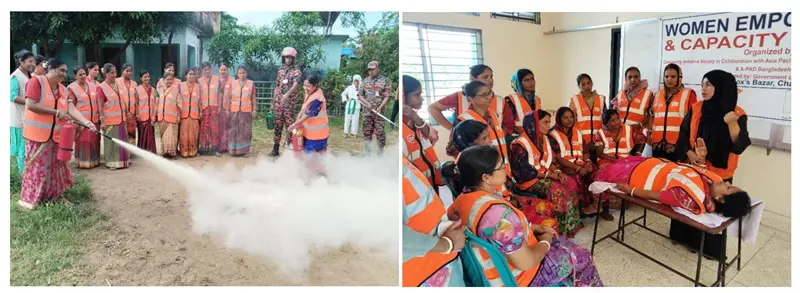
3-2 a) Women Empowerment and Capacity Building | A-PAD Bangladesh conducted Women Empowerment and Capacity Building at Cox’s Bazar where 23 persons have participated. | |
Target : Women’s groups in target villages 20 people ( 2 days ) × 8 divisions × 2 times = 320 people | 16-17 September 2025, Cox’s Bazar, Total Participants 20+4=24 Participants In the high-risk context of Cox’s Bazar, vulnerable to cyclones, landslides, and flash floods, a targeted Disaster Risk Reduction | |
| (DRR) drilling exercise was conducted specifically for women | |
| from local communities in Cox’s Bazar. The Drilling empowered | |
| over 24 women with practical, hands-on skills to act as first | |
| responders within their congested camps and neighborhoods. | |
| The drills focused on scenario-based exercises, including early | |
| warning dissemination in Rohingya dialect and Bangla, safe |
|
| evacuation routes through challenging terrain, and managing |
makeshift cyclone shelters with a focus on the safety and | ||
specific needs of women and infant. Participants practiced first | ||
aid for landslides and storm-related injuries, and learned to use | ||
basic equipment to secure shelters during strong winds. This | ||
initiative not only built critical life-saving capacity but also | ||
formally recognized and integrated these women into the | ||
community’s emergency response framework, fostering | ||
greater resilience and agency in the face of recurring disasters. | ||
3-2 b) Disaster Drilling for the Youth and Local Stakeholders Target:Youth in the local | A-PAD Bangladesh conducted Youth and Local Stakeholder Drilling at Rangpur where 45 persons have participated.
15-16 September 2025, Rangpur, Total Participants 45 Participants | |
private and civic sector 45 people ( 2 days ) × 8 | In a proactive move to bolster community-led disaster | |
divisions × 2 times = 720 people | response in Rangpur, a collaborative drilling exercise was conducted, strategically engaging both youth volunteers and | |
| local stakeholders in Rangpur where 45 participants joined. | |
| Recognizing the region’s susceptibility to sudden flash floods | |
| and debilitating cold waves, the simulation focused on a | |
| coordinated response to a dual disaster scenario. Young | |
| volunteers from local colleges practiced door-to-door early | |
| warning dissemination and assisted in the evacuation of | |
| vulnerable families to pre-identified high-ground shelters, | |
| while local government officials, farmers’ association |
|
| representatives, and community leaders managed on-ground coordination and resource allocation. A key component of the drill involved testing communication chains between the youth, using mobile technology, and the established disaster management committees. This integrated approach not only equipped the next generation with practical skills but also strengthened the entire community’s fabric, ensuring a more resilient and synchronized response to Rangpur’s unique environmental challenges. |
3-2 c) Disaster Drilling for Junior High Schools Target:School Children 40 people ( 2 days ) × 8 divisions × 2 times = 640 people |
|
- Challenges
Practice in collaboration with A-PAD Bangladesh Network Partners Please write good practice in collaboration with partner organizations
- Any contribution Funds Received and Grants Applied / Planned and Implemented Projects by CIS including Emergency Response
Please write Projects name and its fund resources
- Relationship with Bangladesh Government and Japanese Embassy Please write about Meeting with Government office