Project Title: Strengthening Capacity for Sustainable Disaster Management Network by involving multi-sectoral platform Project Period: 17 January, 2023 – 16 January, 2024 (12 month)
- Project Activities and Accomplishments
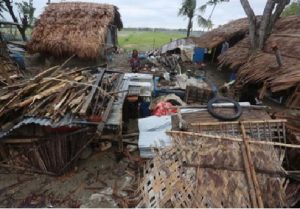
Bangladesh is widely recognized as one of the countries most vulnerable to the impacts of climate change due to its geographical location, high population density, and socio-economic characteristics. Situated in the delta of three major rivers—the Ganges, Brahmaputra, and Meghna—the country is highly exposed to a wide range of climate-induced hazards such as cyclones, floods, storm surges, riverbank erosion, droughts, and salinity intrusion. These hazards are increasing in frequency and intensity as a result of climate change, posing significant threats to lives, livelihoods, infrastructure, and ecosystems. Recurrent disasters disrupt livelihoods, damage infrastructure, degrade natural resources, and trap vulnerable populations in cycles of poverty and risk. Disaster management efforts in Bangladesh are often implemented through sector-specific interventions, which may lead to fragmented planning, limited coordination, and duplication of efforts among stakeholders. Government agencies, local authorities, NGOs, community organizations, research institutions, and development partners all play important roles in disaster risk reduction and climate adaptation. However, the lack of strong coordination mechanisms and knowledge-sharing platforms can limit the effectiveness and sustainability of interventions.
In this context, a network approach offers a promising pathway to enhance resilience by strengthening collaboration, coordination, and knowledge exchange among multiple stakeholders. A network approach emphasizes partnerships among government institutions, civil society organizations, academic institutions, community groups, and private sector actors to collectively address complex and interconnected challenges posed by climate change and disasters. In Bangladesh, where climate risks intersect with development challenges, strengthening multi-stakeholder networks can play a critical role in transforming vulnerability into resilience. Through improved coordination, shared learning, and collaborative action, a network-based approach can enhance the effectiveness of disaster preparedness, response, recovery, and long-term climate adaptation strategies.
In each division, there is one health worker responsible for conducting home visits to raise awareness within the local community regarding fundamental disaster management issues. These health workers also disseminate crucial information concerning government directives or any disaster-related announcements to the community. As of January (17-31) 2026, A-PAD Bangladesh has successfully benefited a total of 1,295 individuals.
1. Operation of Emergency Disaster Management Coordination Center/ Sub Centers (Outcome 1)
The Emergency Disaster Management Coordination Centers in the eight divisions will become regional focal points and be strengthened in their functions. New Upazila-level sub-centers will be piloted to provide decentralized support and coordination in disaster preparedness, response, and recovery. . | ||
Activities | Outcome Indicators to Measure Results: | Project Status: Achievements vs Outcome: If the activity is behind the schedule, please write the reason. |
1-1 Operation of Emergency Disaster Management Coordination Center and Establishment of Sub Centers Beneficiaries: 15 people×25 days × 8 divisions × 12 months = 36,000 people | 1-1 :Establish sub-centers at the district level and develop basic facilities in all eight emergency disaster management coordination centers in Bangladesh. 36,000 local residents (per year) will visit the facilities, raising awareness of health and public hygiene and strengthening disaster preparedness through coordination among partners. In the event of an actual emergency disaster, rescue and medical support will be provided. (Verification method: Number of users, records of usage) 1-2 :80% of the 4,320 participants respond that they are able to access early warning systems and take action in the event of an actual disaster, through the community meetings in at least 10 unions in each district. (Verification method: Pre- and post-activity questionnaire survey results) 1-3 : 80% of the 4,320 participants respond that they are able to take action appropriately for disaster prevention in | Total 815 people visited to the Disaster Management Coordination Center to discuss about disaster preparedness and health related issues. Dhaka: 96 Persons Cox’s Bazar: 120 Persons Pabna: 106 Persons Bagerhat: 85 Persons Patuakhali: 102 Persons Habiganj: 98 Persons Rangpur: 100 Persons Netrokona: 108 Persons Total = 815 Persons |
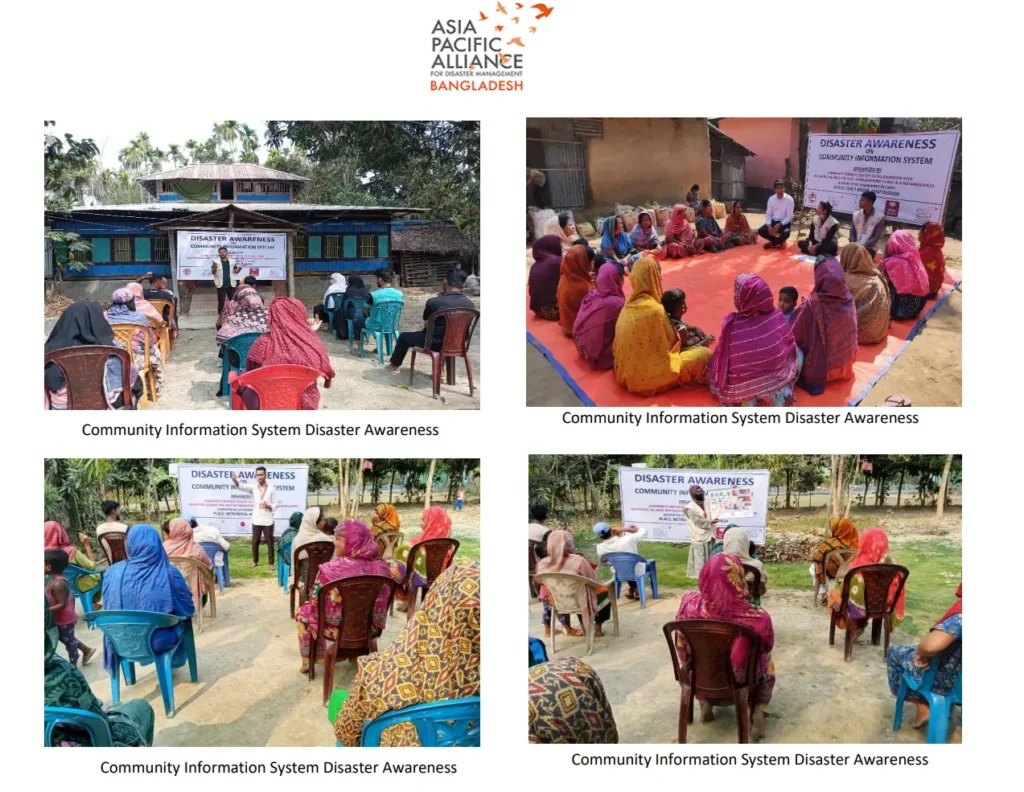
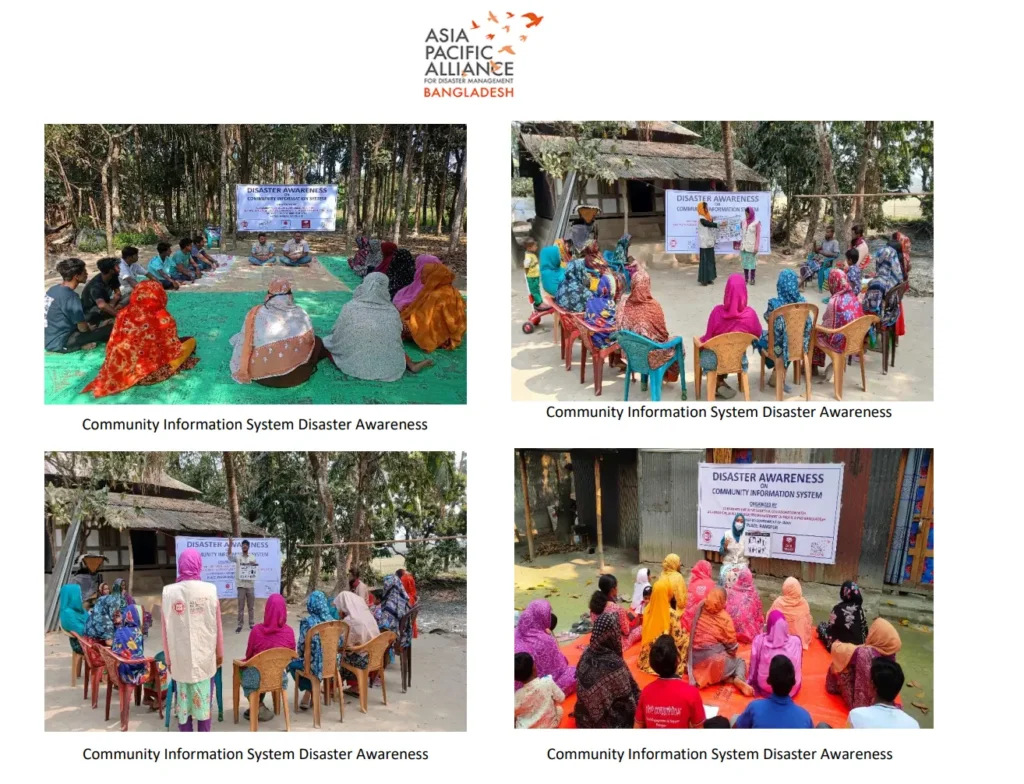
1-2 Community Information System Disaster Awareness Beneficiaries: 15 people × 8 divisions × 3 times ×12 months =4,320 people | A-PAD Bangladesh conducted Community Information System Disaster Awareness program in 8 divisional areas where 240 participants joined. Dhaka:15 Participantsx 2 Sessons= 30 Participants Cox’s Bazar: 15 Participantsx 2 Sessons= 30 Participants Pabna: 15 Participantsx 2 Sessons= 30 Participants Bagerhat: 15 Participantsx 2 Sessons= 30 Participants Patuakhali: 15 Participantsx 2 Sessons= 30 Participants Habiganj: 15 Participantsx 2 Sessons= 30 Participants | |
| the event of an actual disaster, understanding disaster risks and vulnerabilities in their residential environments and respond, through mapping conducted during community meetings. (Verification method: P Pre- and post-activity questionnaire survey results) (Outcome 2)Through strengthening multi-sector networks centered on the community, disaster management plans reflecting local risks and needs will be developed, realizing a dramatic improvement in DRR capabilities and disaster resilience. 【Indicators of Outcome】 | Rangpur: 15 Participantsx 2 Sessons= 30 Participants Netrokona: 15 Participants x 2 Sessons= 30 Participants |
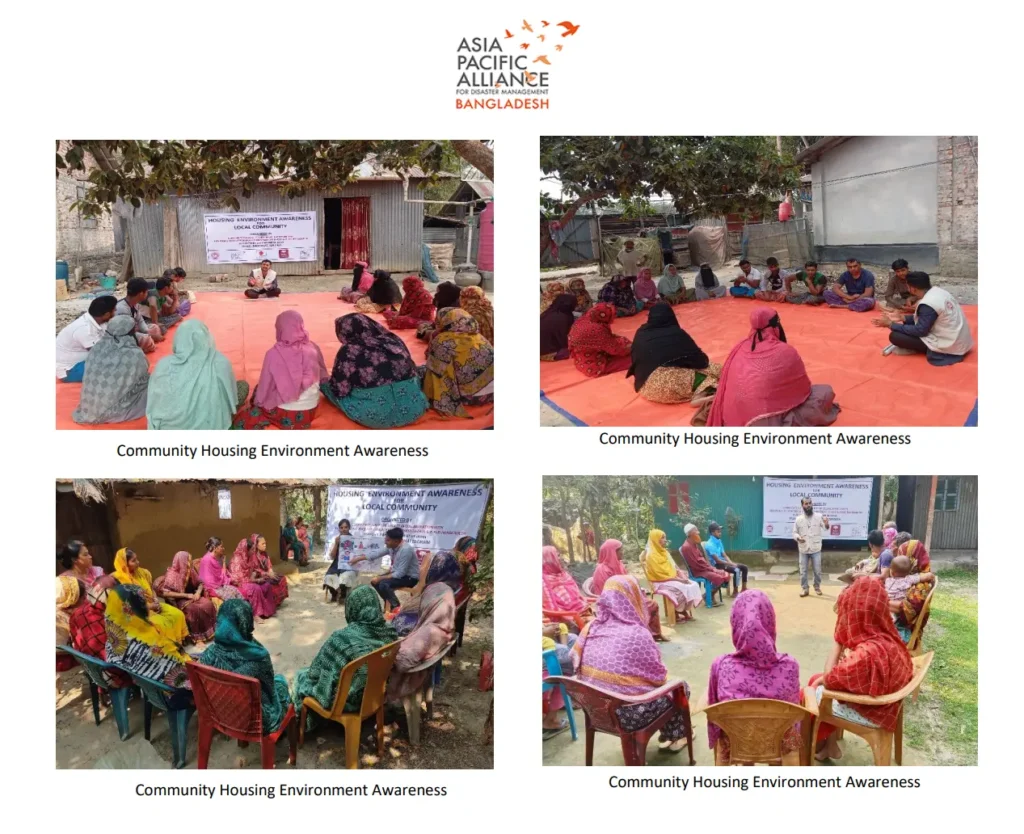
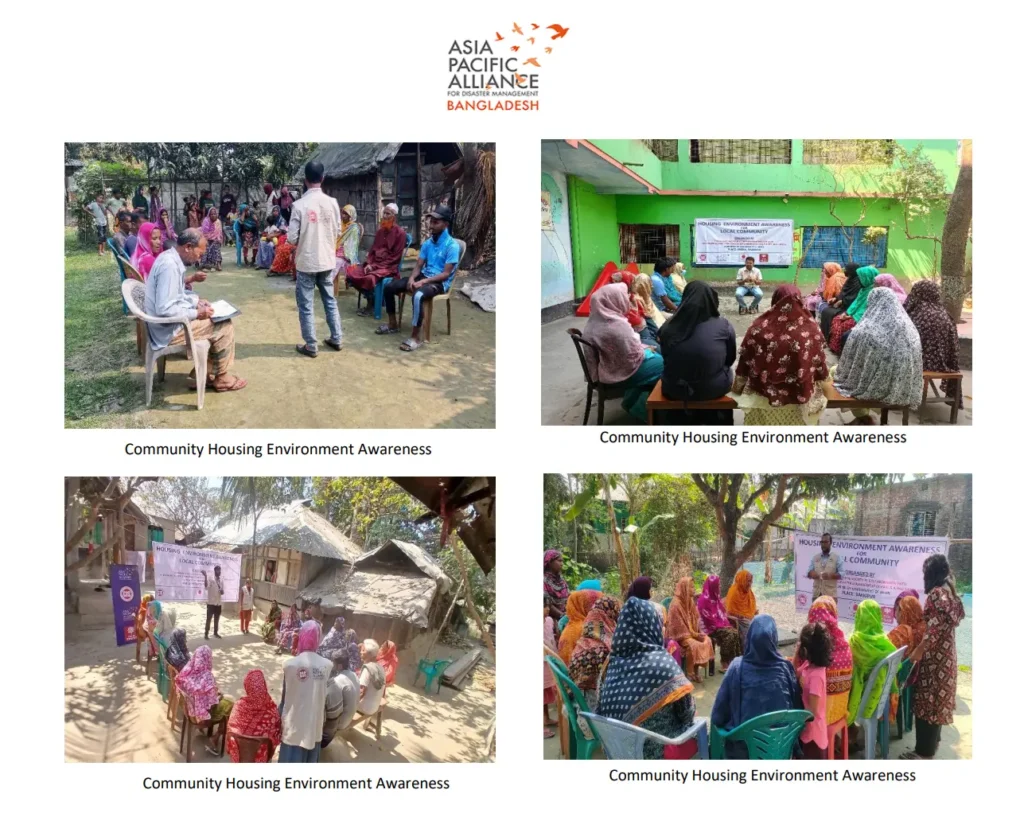
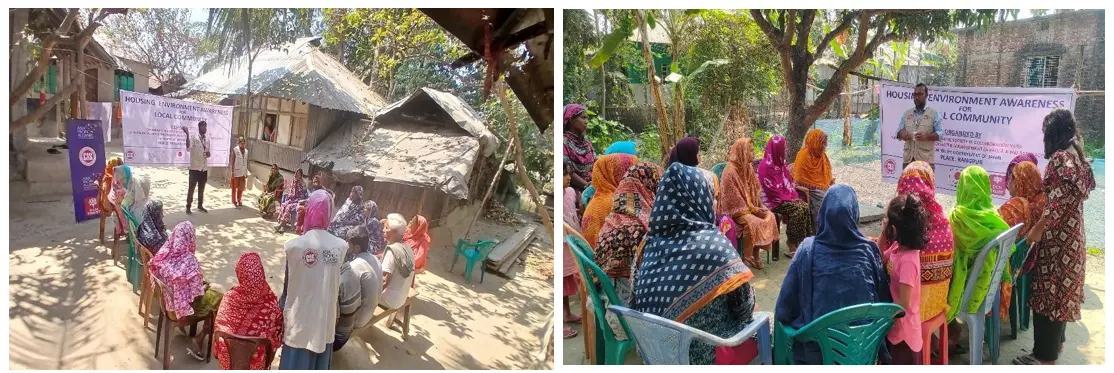
1-3 Community Housing Environment Awareness Beneficiaries: 15 people × 8 divisions × 3 times ×12 months =4,320 people | A-PAD Bangladesh conducted Community Housing Environment Awareness program in 8 divisional areas where 240 participants joined. Dhaka:15 Participantsx 2 Sessons= 30 Participants Cox’s Bazar: 15 Participantsx 4 Sessons= 60 Participants Pabna: 15 Participantsx 2 Sessons= 30 Participants Bagerhat: 15 Participantsx 2 Sessons= 30 Participants Patuakhali: 15 Participantsx 2 Sessons= 30 Participants Habiganj: 15 Participantsx 2 Sessons= 30 Participants Rangpur: 15 Participantsx 2 Sessons= 30 Participants Netrokona: 15 Participants x 2 Sessons= 30 Participants | |
2. Networking Through Community Disaster Management Systems And Action Plans (Outcome 2) A-PAD BGD, NPF for disaster reduction and disaster response through collaboration between multi-sectors, will be established and expanded, and the disaster prevention and disaster capacity of its member organizations will be strengthened. | ||
2.1 Disaster Planning Networking Meeting Participants: 50 people × 5 villages × 8 divisions = 2,000 people | 【Indicators of Outcome】 2-1 Strategies, mechanism and action plan meeting among networking partners and local communities will be held to support the building of disaster cooperation framework.
2-2 For the aim of awareness and increase the knowledge on disaster preparedness and management among the local community, we will organize different rally and meeting on the disaster preparedness and SDGs related | Results of the Self-assessment Required document; – List of resources such as supplies, people and donations provided by partner organizations for a three-year emergency disaster response |
2.2 Comprehensive DRR | Status of strategic planning meeting | |
Training for Network Partner Partici pants:25 people × 2 organizations × 2 times × 8 divisions = 800 people | national/international days like 05 November World Tsunami Awareness Day, 13 October Disaster Risk Reduction Day, 22 April Earth Day and 16 December Victory Day (National). | Required document; Strategic Plan |
2.3 Co-creation Seminar on Innovating Together for Future Disaster Preparedness (DRR Participants:30 people x 2 org x 8 divisions x 2 times =960 people | 2-3 For the aim of strengthening of partner organizations, disaster risk reduction (DRR) training will be held. The training contents includes community-based disaster risk management, planning DRR strategies, and risk analysis that effectively identifies hazards, capacities and vulnerabilities. (Indicator: Partner organizations) 2-4 In this seminar, participants from various fields will be invited to exchange opinions and discuss ways to discover innovations related to DRR proposed by community residents and local companies and realize ideas and inventions. (Indicator: To create innovative solutions, we aim to create a successful model for disaster response by combining technology and knowledge that transcends fields and innovating) | Status of DRR training |
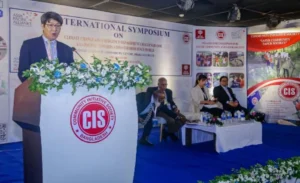
2-4 International Symposium on DRR
Participants:200 persons | Questionaries about the symposium Required Document; Symposium Report | |
| 2-5 The international symposium will be held in Dhaka to widely share the cooperation between multi-actors at the central and regional levels in Bangladesh and the progress of the emergency health response system among participants who are involved in disaster response from inside and outside |
|
| Bangladesh. International experts will be dispatched from A-PAD member countries to introduce advanced cases of NPF in each country. (Indicator: The international symposium will be held for a total of three days, one day for field trips (field visits), one day for pre-meetings, and one day for international symposiums.) |
|
3. Empowering Vulnerable Communities through Comprehensive Disaster Preparedness Training (Outcome 3) 3-1 Capacity Building for Community Level Disaster Response in Health and Hygiene | ||
3-1 a) Integrated Emergency Disaster Response Workshop Participants : 30 people ( 2days ) × 2 times× 8 divisions =480 people | 【Indicator of Outcome】 3-1 a) Workshops will be held to understand emergency disaster preparedness, health response and hygiene needs in communities, schools and homes and to learn how to respond during emergencies. Networks of stakeholders will be built through the workshop.
(Indicator: Local citizens, Community leaders, Local NGO, Private sector workers) b) Workshop for health workers from local organizations will be held to understand emergency health and hygiene needs and learn how to respond to emergencies. The health workers who finished this trainings are supposed to become member of disaster volunteer rescue team in the activity. | list of community leaders who can lead emergency response for disaster response/emergency health in all 7 districts. (3 years) |
3-1 b) Mental Health Training
Participants:25 people(3 days ) × 8 divisions = 200 people | list of 25 NGO health response personals who can respond in an emergency, cases of activities during an emergency disaster in all districts, and the number of residents provided with services (3 years) | |
3-2 Strengthening Local Communities’ Emergency Response through Disaster Drill | ||
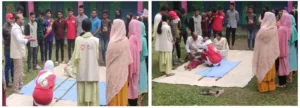
3-2 a) Women’s Emergency Response Simulation Drill Participants:25 people(2 days)× 2 times× 8 divisions =400 people | 3-2 a) Building women empower and capacity building through improving their knowledge and skills on disaster risk reduction, in order to involve them in disaster planning and policy making. A women’s group will be trained in the field of maternal and child health, hygiene and environment sanitation, nutrition. (Indicator: A women’s group will be trained in the field of maternal and child health, hygiene and environment sanitation, nutrition.)
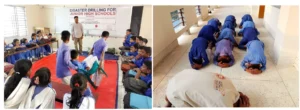
b) Drilling training session will be conduct to the local stakeholders, youth group and homes and to learn how to respond the fire, flood, cyclone, landslide and earthquake disasters and rescue at the emergencies. To conduct this training session, we will prepare a training manual and a curriculum collaboration with the department of fire service and civil defense of GoB. (Indicator: After the practical training session two disaster volunteer rescue team will be established in each divisional area.) c) Drilling training session for the public junior high school students and teachers will conduct at the school based focusing self-protection during and after disaster. Manual will be designed for the school children in | Status of seminar and actual public-private partnership practice case |
b) Inclusive Simulation Drill for Empowering Youth, Stakeholders, and Persons with Disabilities Participants:45 persons x 8 divisions x 2 times = 720 persons |
| |
3-2 c) Junior High School Simulation Drill Participants:40 people(2 days ) × 2 times × 8 divisions = 640 people |
|
| cooperation with the department of fire service and civil defense of GoB (Indicator: Participated schools will be supported to develop their emergency management plans.) |
|
3-2 d) Emergency Medical Response Network Drill Participants:40 people(2 days ) × 2 times × 8 divisions = 640 people | In order to widely share and disseminate the activities of this project and the experiences and lessons learned through the activities, situation reports and activity reports in the event of a disaster will be published on the A-PAD BGD website. |
|
3-3 Update website contents as E-resources for Disaster Management | https://apad-bd.org/our-national-platform-members/ https://apad-bd.org/a-pad-bangladesh-activity-report- month-of-january-1-16-2026/ |
- Challenges
Please write Challenges and its impact upon the project implementation. (Ex. lockdown, Political situation, Curfew)
- Practice in collaboration with A-PAD Bangladesh Network Partners Please write good practice in collaboration with partner organizations
- Any contribution Funds Received and Grants Applied / Planned and Implemented Projects by CIS including Emergency Response Please write Projects name and its fund resources
- Relationship with Bangladesh Government and Japanese Embassy Please write about Meeting with Government officials